

Prebiotics vs Probiotics vs Postbiotics: What's the Difference and Which Do You Need?
The gut microbiome is one of the most actively researched areas in modern nutritional science, and for good reason. The trillions of microorganisms living in the digestive tract play a role in everything from nutrient absorption to immune function to day-to-day digestive comfort. As research in this space has grown, so has the vocabulary — and three terms keep appearing at the center of the conversation: prebiotics, probiotics, and postbiotics. Understanding what each one is, how they differ, and how they work together is the foundation of any smart gut-health routine. This article breaks all three down clearly, so you can make an informed decision about what belongs in your daily stack.
⭐ Save $54 on the 90-day plan — the time it takes for real gut microbiome change.
What Are Probiotics?
Probiotics are live microorganisms — primarily bacteria, and sometimes yeasts — that, when consumed in adequate amounts, are associated with benefits for the host. In plain terms: they are the living microbes you introduce into your digestive system through food or supplements.
Common probiotic strains include Lactobacillus acidophilus, Bifidobacterium longum, and Saccharomyces boulardii. Each strain has a distinct profile of activity in the gut, which is why strain diversity matters. Fermented foods like yogurt, kefir, sauerkraut, and kombucha are naturally rich in live cultures and have been consumed across cultures for thousands of years precisely because of their association with digestive wellbeing.
In supplement form, probiotics are measured in CFUs — colony-forming units — which indicate how many viable organisms are present per serving. A quality probiotic supplement or probiotic-forward gummy will disclose both the strain names and the CFU count, giving you a clear picture of what you are actually consuming.
If you are newer to this topic, the Complete Beginner's Guide to Probiotics is a helpful place to start before going deeper into the science.
What Are Prebiotics?
Prebiotics are the fuel that probiotics run on. More precisely, prebiotics are non-digestible dietary fibers and compounds that selectively feed beneficial bacteria already living in the gut. The human digestive system cannot break down these fibers itself — but the beneficial microbes in the colon can ferment them, and in doing so, they produce metabolites that support a balanced microbial environment.
Common prebiotic compounds include inulin, fructooligosaccharides (FOS), galactooligosaccharides (GOS), and pectin. These are found naturally in foods like chicory root, garlic, onions, green bananas, and oats. When consumed regularly, prebiotic-rich foods help create the conditions in which beneficial bacteria can thrive.
Here is an important distinction that is often overlooked: adding probiotics to your routine without adequate prebiotic support is a bit like planting seeds in dry soil. The beneficial microbes need something to feed on. Prebiotics are that nourishment. This is why the most comprehensive gut-health formulations include both prebiotics and probiotics together — a combination sometimes referred to as a "synbiotic."
- Inulin — A soluble fiber from chicory root, widely studied for its prebiotic activity.
- FOS (Fructooligosaccharides) — Short-chain fibers that selectively support Lactobacillus and Bifidobacterium species.
- GOS (Galactooligosaccharides) — Derived from lactose; associated with support for gut microbial diversity.
- Pectin — Found in apple skins and citrus peel; ferments slowly in the colon to support a broad range of beneficial microbes.
What Are Postbiotics — And Why Do You Need Them?
This is where many gut-health conversations stop short — and where the most exciting recent research begins. So what are postbiotics and why do you need them? The short answer: postbiotics are what probiotics produce after they have fermented prebiotics. They are the bioactive byproducts of microbial activity, and emerging science suggests they may be the most directly bioavailable of the three.
The International Scientific Association for Probiotics and Prebiotics (ISAPP) formally defined postbiotics in 2021 as "preparations of inanimate microorganisms and/or their components that confer a health benefit on the host." In simpler language: postbiotics include things like short-chain fatty acids (SCFAs), enzymes, peptides, and cell wall fragments produced during fermentation. Because they are already metabolized, the body does not need to process them further the way it does with live probiotics — they are essentially ready to be used.
Key postbiotic compounds include:
- Butyrate — A short-chain fatty acid that serves as a primary energy source for colonocytes (the cells lining the colon) and is associated with supporting gut barrier integrity.
- Acetate and Propionate — SCFAs that play roles in metabolic signaling and immune modulation.
- Bacteriocins — Antimicrobial peptides produced by beneficial bacteria that help maintain microbial balance.
- Exopolysaccharides — Complex sugars secreted by probiotic bacteria, associated with supporting the intestinal lining.
One practical advantage of postbiotics over live probiotics is stability. Live bacteria are sensitive to heat, moisture, and stomach acid — meaning delivery to the colon is not guaranteed. Postbiotics, being non-living bioactive compounds, are inherently more stable across different storage and transit conditions. This makes them particularly well-suited for delivery formats like gummies, where the manufacturing process involves heat.
Understanding what are postbiotics and why you need them also means recognizing that this is not a replacement for probiotics or prebiotics — it is an addition. The three work synergistically. Prebiotics feed probiotics; probiotics ferment those prebiotics and produce postbiotics; postbiotics then exert their own supportive effects on the gut environment and beyond. Remove one link, and the chain is incomplete.
Thousands of people have already made the switch. ★★★★★ 4.8 from 1,019 reviews.
The 90-Day Gut Reset Plan — $66 (normally $120)
Start My 90-Day Reset →How Pre, Pro, and Postbiotics Work Together
The gut microbiome is not a static system — it is a dynamic, interactive ecosystem. Prebiotics, probiotics, and postbiotics each operate at a different stage of the same biological process, and their combined presence creates a more complete foundation for digestive support than any single category can provide alone.
Think of it as a three-part cycle:
- Prebiotics set the stage — by providing fermentable substrates that selectively nourish beneficial bacteria over potentially harmful ones.
- Probiotics do the work — live beneficial strains consume those prebiotics, colonize the gut environment, and compete for space with less desirable organisms.
- Postbiotics deliver the output — the metabolic products of fermentation act on gut cells, the immune system, and the broader microbiome in ways that are increasingly well-documented by research.
Research published in journals including Nutrients, Frontiers in Microbiology, and Cell Host & Microbe has explored the interplay between these three categories, with consistent findings suggesting that combined approaches may be more effective than single-category interventions at supporting microbial diversity and digestive comfort over time.
It is also worth noting that gut health does not operate in isolation. The gut-brain axis, the gut-immune connection, and the relationship between the microbiome and metabolic health are all areas of active scientific inquiry. A well-supported gut microbiome — nourished with prebiotics, populated with diverse probiotics, and benefiting from postbiotic metabolites — is the baseline from which these broader systemic benefits may follow. For a closer look at one of those connections, see our article on whether probiotics can support weight management.
Prebiotics vs Probiotics vs Postbiotics: A Side-by-Side Summary
To make the distinctions concrete, here is a direct comparison across the key attributes of each category:
- What they are: Prebiotics = non-digestible fibers and compounds. Probiotics = live beneficial microorganisms. Postbiotics = bioactive byproducts of microbial fermentation.
- Where they come from: Prebiotics are found in fibrous plant foods. Probiotics are found in fermented foods and supplements. Postbiotics are produced inside the gut during fermentation, or can be delivered via supplements containing stabilized postbiotic preparations.
- How they work: Prebiotics feed microbes. Probiotics are the microbes. Postbiotics are what the microbes produce.
- Stability: Prebiotics are generally shelf-stable. Probiotics are sensitive to heat, light, and moisture. Postbiotics are highly stable.
- Best for: All three are complementary — the strongest gut-health formulations combine them.
"The gut microbiome is shaped not just by what lives there, but by what those organisms are fed and what they produce. Prebiotics, probiotics, and postbiotics each address a different part of that equation."
Why Getting All Three in One Place Makes Sense
Sourcing prebiotics, probiotics, and postbiotics separately — through a combination of diet, standalone supplements, and fermented foods — is entirely possible. But it requires consistency across multiple products, attention to storage requirements for live probiotic cultures, and a reasonable level of dietary diversity. For many people building a daily wellness routine, that level of complexity becomes a barrier to actually following through.
This is the gap that GutBio Kombucha Gummies are formulated to fill.
GutBio is designed as a complete gut-health gummy — one that delivers prebiotics, live probiotic cultures, and postbiotic compounds in a single low-sugar, easy-to-take daily format. The kombucha-based formulation draws on one of the most traditionally celebrated fermented sources of gut-supportive compounds, modernized into a format that fits into any routine.
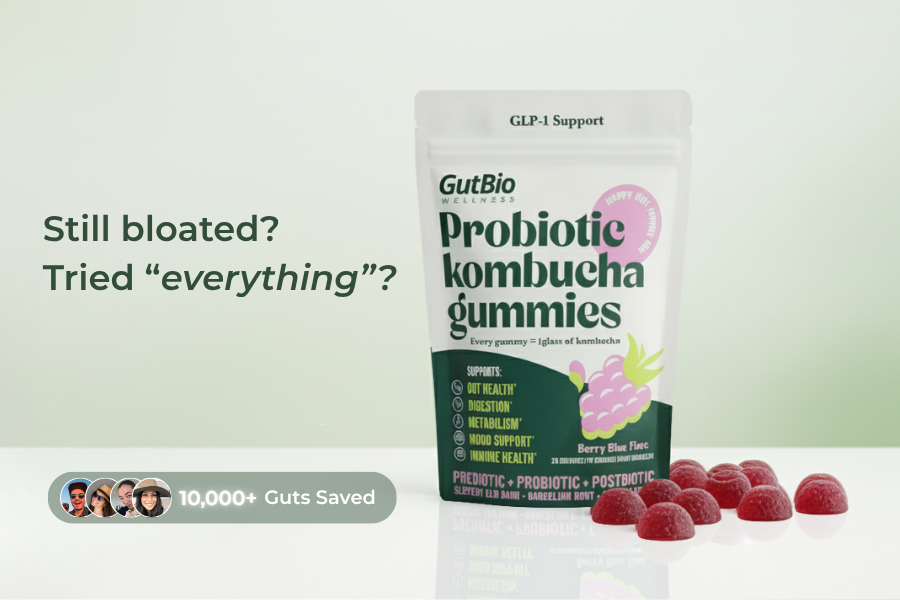
The formulation combines:
- Prebiotics to nourish the beneficial bacteria in the gut.
- Live probiotic strains drawn from kombucha fermentation tradition, to support microbial diversity.
- Postbiotic compounds delivered in a heat-stable format that survives the gummy manufacturing process — addressing one of the most common formulation challenges in the category.
GutBio Kombucha Gummies are low in sugar — an important consideration given that excess added sugar in the diet has been associated with less favorable conditions for beneficial gut bacteria. They are designed for daily, consistent use as part of a broader approach to digestive wellness.
Rated 4.8 stars from over 1,019 verified reviews, GutBio has built a loyal daily-use customer base. And for anyone who wants to explore whether it fits into their routine, there is a 60-day money-back guarantee — making it a genuinely low-risk starting point for anyone curious about combining all three biotics in one place.
For an independent deep-dive on how kombucha gummies are formulated and what the research says about their efficacy, see: Do Kombucha Gummies Actually Work? An Honest, No-BS Review.
Common Objections — Answered Honestly
Is a gummy format actually effective for probiotics?
It is a fair question. Traditional probiotic supplements often come in capsule form with enteric coating designed to survive stomach acid. Gummies present a manufacturing challenge: the heat required to set the gelatin or pectin base can degrade live cultures. GutBio addresses this through a postbiotic-forward formulation approach — meaning the heat-stable postbiotic compounds are preserved through manufacturing, while the probiotic component is introduced in a way that accounts for viability. The result is a format that does not require refrigeration and maintains its potency at room temperature.
Does combining all three really matter, or is this just marketing?
The scientific rationale for combining prebiotics, probiotics, and postbiotics is grounded in how the gut ecosystem actually functions. Probiotics without prebiotic support have fewer nutrients to sustain their activity. Prebiotics without probiotics have fewer microbes to ferment them. Postbiotics without the upstream prebiotic-probiotic cycle become a standalone delivery of specific metabolites — useful, but not the same as supporting the full cycle. The "all three together" approach is not a marketing construct; it reflects the underlying biology of the microbiome.
What if it is not right for me?
GutBio Kombucha Gummies come with a 60-day money-back guarantee. That means there is a full two-month window to assess whether the product is a fit for your routine. If it is not, a refund is available — no complicated process. That kind of policy reflects confidence in the formulation and removes the financial risk from trying something new.
Frequently Asked Questions
What are postbiotics and why do you need them in a gut-health supplement?
Postbiotics are the bioactive compounds produced when probiotic bacteria ferment prebiotic fibers. They include short-chain fatty acids like butyrate, antimicrobial peptides, and enzymes that act directly on gut cells and the broader microbiome environment. Because they are not
These statements have not been evaluated by the Food and Drug Administration. This product is not intended to diagnose, treat, cure, or prevent any disease. Individual results may vary. Always consult your healthcare provider before starting any new supplement.