

Slippery Elm Bark: What It Does for Your Gut
Slippery elm bark (Ulmus rubra) is an inner tree bark used in traditional North American herbal medicine for centuries. Its active component — a soluble fibre called mucilage — forms a gel-like coating when it contacts water, which is why research and traditional use both centre on its ability to support digestive comfort and gastrointestinal tract health.[1]
⭐ Save $54 on the 90-day plan — the time it takes for real gut microbiome change.
What is slippery elm bark, and where does it come from?
Slippery elm is a medium-sized deciduous tree native to eastern North America. The inner bark — the layer between the rough outer bark and the wood — is dried and ground into a coarse powder or extracted as a liquid. That inner bark is where the medicinal compounds concentrate.
The key constituent is mucilage, a complex mixture of polysaccharides (mainly arabinogalactan, galactose, and 3-methyl galactose) that swells into a thick, slippery gel when it absorbs water.[2] This gel is what distinguishes slippery elm from most other herbal gut supplements, which rely primarily on antimicrobial or antioxidant mechanisms rather than a physical coating action.
Slippery elm bark is classified as a demulcent — an agent that soothes and protects mucous membrane surfaces — and has held that classification in the United States Pharmacopeia since the 19th century.
How does slippery elm bark work in the digestive system?
The dominant mechanism is physical rather than pharmacological. When slippery elm powder or extract reaches the gastrointestinal tract, the mucilage hydrates and expands, creating a viscous layer along the mucosal surface. This layer is thought to act as a protective film over the intestinal lining.[1]
The mucilage coating mechanism
Mucilage molecules are negatively charged polysaccharides. The intestinal mucosa carries a net negative surface charge as well, but the mucilage interacts with glycoproteins in the mucus layer to adhere loosely to the gut wall. The result is a supplementary viscous barrier on top of the body's own mucus layer.
This is believed to:
- Reduce direct contact between gastric acid and sensitive tissue in the upper GI tract
- Slow the transit of liquids slightly, which may support a sense of digestive comfort
- Contribute fibre that feeds beneficial bacteria in the colon
Prebiotic fibre activity
The polysaccharide fraction of slippery elm mucilage is fermentable by colonic bacteria — particularly Bifidobacterium and Lactobacillus species. Fermentation of these fibres produces short-chain fatty acids (SCFAs) including butyrate, propionate, and acetate.[3] SCFAs serve as the primary energy source for colonocytes (cells lining the colon) and play a role in maintaining gut barrier integrity. This positions slippery elm as functioning partly as a prebiotic fibre, not only as a demulcent coating agent.
Antioxidant compounds
Beyond mucilage, slippery elm bark contains phenolic compounds including catechins, epicatechin, quercetin, and beta-sitosterol.[2] These contribute antioxidant activity in vitro, though their specific contribution to digestive outcomes in humans requires further clinical study.
Thousands of people have already made the switch. ★★★★★ 4.8 from 1,019 reviews.
The 90-Day Gut Reset Plan — $66 (normally $120)
Start My 90-Day Reset →What does the research actually say about slippery elm bark benefits for gut health?
This is where intellectual honesty matters. The research base is promising but limited. Most available evidence comes from small clinical studies, observational data, or in vitro (cell/lab) work. Large, randomised controlled trials with placebo controls are scarce. Here is a transparent summary of what the evidence supports and what remains unproven.
What is reasonably well-supported
| Claimed benefit | Level of evidence | Notes |
|---|---|---|
| Demulcent / soothing action on GI mucosa | Mechanistically plausible; traditional use; limited clinical data | The mucilage gel mechanism is chemically well-characterised; clinical trials are small |
| Prebiotic fibre fermentation and SCFA production | In vitro and animal data; limited human trials | Polysaccharide structure is consistent with fermentable prebiotic activity[3] |
| Support for bowel regularity | Traditional use; small clinical studies | A 2002 pilot study noted improvements in stool consistency in a mixed-herb formulation including slippery elm[4] |
| Antioxidant activity | In vitro evidence | Not well-studied in human GI-specific endpoints |
What is not yet well-supported
- Slippery elm has not been shown in large RCTs to treat or cure any specific digestive condition.
- The majority of human clinical data uses slippery elm in multi-ingredient formulations, making it difficult to isolate its specific contribution.
- Optimal dosage and standardisation have not been established by regulatory bodies.
- Long-term safety data beyond short-term use in healthy adults is limited.
"Slippery elm has a long history of use as a demulcent. However, the clinical evidence base remains preliminary and further well-designed human trials are needed to confirm efficacy for specific outcomes." — consistent consensus across systematic herb databases including the Natural Medicines Comprehensive Database and Memorial Sloan Kettering Cancer Center herb summaries[5]
How does slippery elm bark compare to other gut-supportive fibres?
Slippery elm sits in a wider category of mucilaginous or gel-forming dietary fibres. Understanding how it compares helps clarify its specific role.
| Fibre / compound | Primary mechanism | Evidence base | Notable difference |
|---|---|---|---|
| Slippery elm bark | Mucilage coating; prebiotic fermentation | Small clinical studies; in vitro | Bark-derived; combines demulcent + prebiotic action |
| Psyllium husk | Gel-forming soluble fibre; bulking | Strong RCT evidence for bowel regularity[6] | Largest human evidence base of gel fibres |
| Marshmallow root | Mucilage demulcent | Very limited human trials | Similar mechanism to slippery elm; less studied |
| Inulin / FOS | Prebiotic fermentation only | Moderate RCT evidence | No coating action; purely fermentable |
| Beta-glucan (oats) | Viscous soluble fibre; bile acid binding | Strong RCT evidence for cholesterol; moderate for gut | Dual cardiovascular + gut applications |
Slippery elm's combination of a coating action and fermentable fibre activity is somewhat unique in this group. However, for applications where robust clinical evidence is required, psyllium and beta-glucan currently have a stronger research record in humans.
How is slippery elm bark typically used, and what forms does it come in?
Slippery elm bark is available in several product formats, each with practical differences in convenience and likely bioavailability of the mucilage fraction.
- Powder (loose): The most traditional form. Mixed with water, it produces a porridge-like gruel. The mucilage activates fully in liquid. Higher mucilage contact with GI tissue is expected.
- Capsules / tablets: Convenient, standardised dose. The powder is encapsulated without added liquid. The mucilage will hydrate with GI fluids after ingestion, though the extent of coating action may be less pronounced than the gruel form.
- Lozenges: Historically used to soothe the throat and upper oesophagus. The mucilage can act topically in the oropharynx before swallowing.
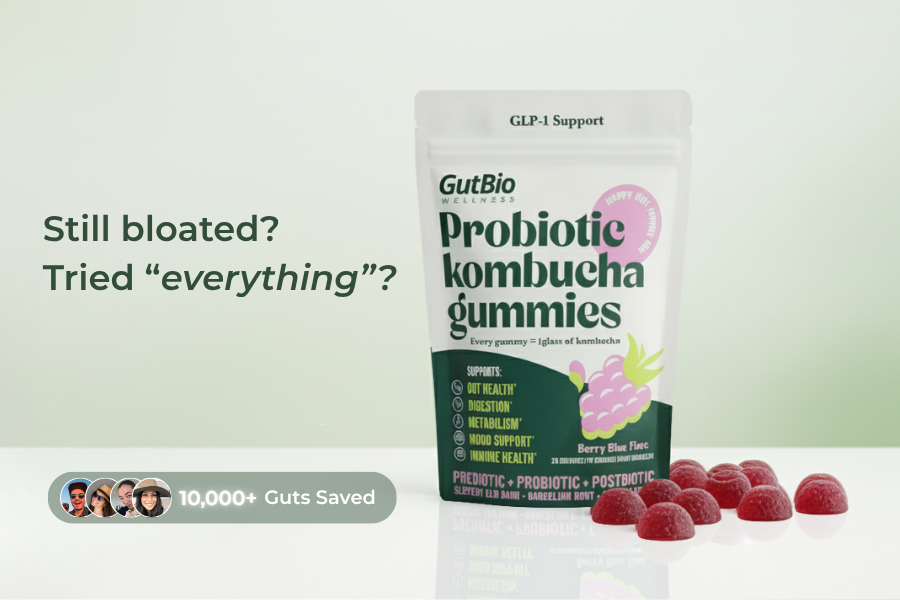
- Gummy / chewable formats: Emerging in modern supplement lines where slippery elm is included alongside other gut-supportive ingredients. Some formulations, like GutBio Kombucha Gummies, combine slippery elm with a broader spectrum of pre-, pro-, and postbiotic ingredients in a low-sugar, daily-use format.
- Tea / decoction: Traditional method using dried bark simmered in water. Mucilage content varies by preparation time and water temperature.
There is no universally established therapeutic dose for slippery elm. Traditional herbalism commonly references 4–8 grams per day of inner bark powder for adult use, though clinical studies have used a range of doses within multi-ingredient formulations.
Is slippery elm bark safe? Are there known interactions?
Slippery elm bark has a well-established traditional safety profile and is generally regarded as safe at typical dietary supplement doses for short-term use in healthy adults. The U.S. Food and Drug Administration (FDA) has listed slippery elm as a Generally Recognized As Safe (GRAS) ingredient for food use.[1]
Known considerations
- Medication absorption: Because mucilage forms a physical coating on GI membranes, it may theoretically slow the absorption of oral medications taken at the same time. The standard guidance is to take slippery elm supplements at least 1–2 hours apart from prescription medications. Consult a healthcare provider if in doubt.
- Pregnancy and breastfeeding: Some historical herbalism texts reference uterine-stimulating properties of the bark. Current evidence on this is insufficient. Pregnant individuals should consult a medical professional before use.
- Allergies: Rare allergic reactions to elm tree products have been reported. Those with known tree pollen or elm allergies should exercise caution.
- No serious adverse events have been documented in the published literature at typical supplement doses in otherwise healthy adults.
Does taking slippery elm
These statements have not been evaluated by the Food and Drug Administration. This product is not intended to diagnose, treat, cure, or prevent any disease. Individual results may vary. Always consult your healthcare provider before starting any new supplement.