

7 Gut Health Myths That Are Keeping You Bloated (And What Actually Works)
You've tried cutting gluten. You've done the probiotic pills. You've chugged apple cider vinegar because someone on the internet swore it would fix everything. And yet — you're still bloated, still uncomfortable, still pulling your waistband away from your stomach by 3pm. Here's the uncomfortable truth: most of what you've been told about gut health is either outdated, oversimplified, or flat-out wrong. The supplement industry is full of half-truths that keep you buying things that don't work. So let's tear them apart, one by one — and talk about what the science actually says.
⭐ 40% off + free shipping — try GutBio risk-free for 60 days.
Whether you've been researching myths about gut health supplements debunked for a while or you're just starting to question why nothing seems to work, this article is for you. We're going to get specific, get honest, and by the end, you'll know exactly what to look for — and what to finally stop wasting money on.
Myth #1: More Probiotic Strains Always Means a Better Product
Walk into any pharmacy and you'll see probiotic bottles boasting 30, 40, even 50 different bacterial strains. The marketing logic is simple: more strains, more diversity, better gut health. It sounds reasonable. It's also misleading.
Research published in Cell found that the human gut can actually resist colonization by a diverse mix of new bacteria when too many strains are introduced simultaneously. Your gut has its own established ecosystem. Flooding it with dozens of unfamiliar strains doesn't guarantee they'll set up shop — in fact, in many people, the strains simply pass through without taking hold at all.
What matters far more than the number of strains is whether the strains are clinically studied, survivable through the digestive tract, and paired with the right environment to thrive. A handful of well-researched, high-viability strains will outperform a fifty-strain scramble every single time.
That's exactly the philosophy behind GutBio Kombucha Gummies. Instead of throwing every strain at the wall, GutBio uses a curated, targeted probiotic blend — the kind of approach that actually moves the needle on bloating instead of just looking impressive on a label.
Myth #2: Probiotics Alone Are Enough to Fix Your Gut
This is the biggest misconception driving billions of dollars in supplement sales every year. People buy a probiotic, take it for two weeks, see minimal improvement, and assume they just haven't found the "right" one yet. The cycle repeats. The bloating stays.
Here's what most brands won't tell you: probiotics need prebiotics to survive and thrive. Think of probiotics as seeds and prebiotics as the soil. You can plant the best seeds in the world, but if the soil is depleted, nothing grows. Prebiotics — specific fibers and compounds that feed beneficial bacteria — are the missing piece in almost every single probiotic-only supplement on the market.
But it goes even further. There's a third layer that's been largely ignored until recently: postbiotics. These are the metabolic byproducts that beneficial bacteria produce — compounds like short-chain fatty acids (SCFAs) and butyrate — that directly influence gut barrier integrity, inflammation, and yes, bloating. Postbiotics are what your gut actually uses to heal. Without them, you're missing the finish line.
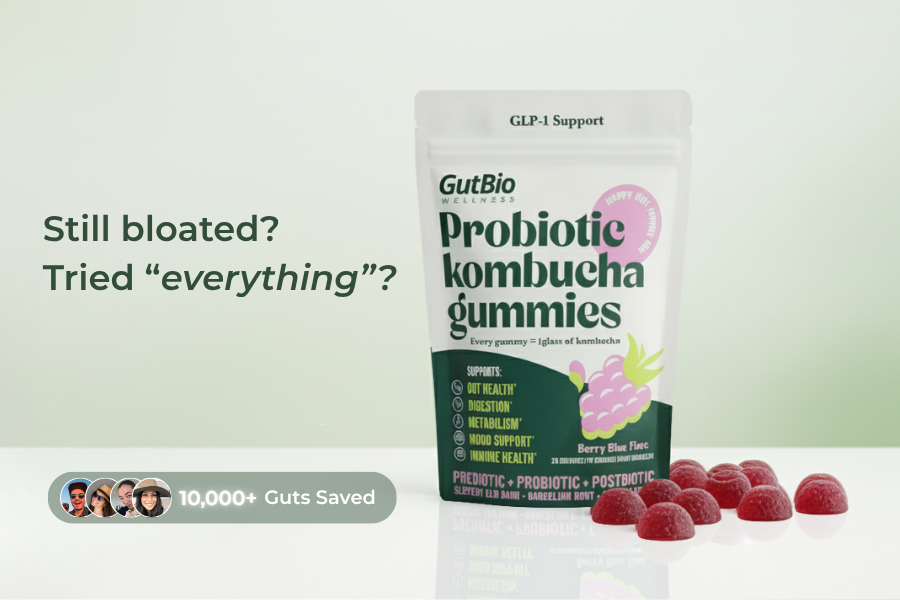
The most effective gut health approach combines all three: pre, pro, and postbiotics working in synergy. This is what GutBio Kombucha Gummies were specifically formulated to deliver — a complete triple-action system, not just a one-note probiotic capsule. If you want to dig deeper into how probiotics actually work in your body, the Complete Beginner's Guide to Probiotics is a great place to start.
Myth #3: If It's Fermented, It's Good for Your Gut
Kombucha, kimchi, kefir, sauerkraut — fermented foods have been elevated to near-mythical status in the wellness world. And yes, fermented foods can be beneficial. But the idea that any and all fermented products automatically deliver meaningful probiotic support is simply not accurate.
The problem is viability and quantity. Most commercial kombucha, by the time it's bottled, refrigerated, shipped, stocked, and purchased, has experienced significant bacterial die-off. Studies suggest the live bacteria count in many grocery store fermented drinks is far lower than what's needed to produce clinical benefit. And if the product has been pasteurized? The beneficial bacteria are largely gone entirely.
Then there's the sugar issue. Many commercial kombuchas contain 10 to 15 grams of sugar per serving — and sugar feeds the very harmful bacteria you're trying to crowd out. You could be actively undercutting your gut health goals with every sip.
GutBio Kombucha Gummies are built around the benefits of kombucha fermentation without the downsides. They're low-sugar by design, and the probiotics are formulated for survivability through the digestive process — so what's on the label is actually what reaches your gut. That's a distinction that matters enormously, and it's one of the reasons so many of the 1,019 five-star reviewers specifically mention that this is the first product that actually made them feel different.
Thousands of people have already made the switch. ★★★★★ 4.8 from 1,019 reviews.
GutBio Kombucha Gummies — $30 (normally $50)
Get 40% Off + Free Shipping →Myth #4: You'll Feel Results Within a Few Days
We live in an age of instant results. Next-day delivery. Two-minute workouts. And supplement brands have learned to exploit that impatience with promises of bloating relief "overnight" or "within 48 hours." It sells product. It also sets people up to quit before they ever give their gut a real chance.
The reality is that your gut microbiome took years to become imbalanced. The bacterial populations living in your digestive tract have been shaped by every antibiotic you've ever taken, every stressful period, every processed food meal. Rebalancing that ecosystem is a biological process — and biology doesn't happen overnight.
Most research on probiotic interventions points to a three-to-four week window before consistent, measurable improvements in bloating, bowel regularity, and digestive comfort become apparent. Some people notice shifts earlier. Others take the full month. The key is consistency, not speed.
GutBio's tagline says it plainly: fix bloating in 30 days. Not 30 minutes. Not 3 days. 30 days of showing up for your gut every single day. And if you're worried about committing to a full month and not seeing results, the 60-day money-back guarantee removes that risk entirely. You have more time to try it than it takes to work.
Myth #5: Gut Health Supplements Are All Basically the Same
This myth is perhaps the most financially damaging one on this list. Because if you believe all gut supplements are interchangeable, you'll buy whatever's cheapest — and then wonder why your bloating persists while you keep cycling through budget options.
The differences in formulation quality are enormous and largely invisible on the front of the label. Here's what actually separates an effective gut supplement from an ineffective one:
- Strain survivability: Can the bacteria survive stomach acid and actually reach the intestine? Most cheap probiotics can't.
- CFU count at time of use: Many products have high CFU counts at manufacturing but massive die-off by expiration. What matters is what's alive when you take it.
- Prebiotic inclusion: Without prebiotic support, probiotics have nothing to feed on and limited ability to colonize.
- Postbiotic delivery: Does the formula actually support the downstream compounds your gut needs to reduce inflammation and strengthen its lining?
- Sugar content: Sugar actively undermines gut health. Low-sugar isn't just a marketing point — it's a functional requirement.
When you stack these criteria up, the gap between a well-designed product and a generic capsule becomes obvious. This is precisely why reading honest, detailed reviews matters — check out this honest, no-BS review of kombucha gummies if you want to see how GutBio holds up under real scrutiny.
Myth #6: Bloating Is Always a Food Intolerance Problem
The moment someone mentions chronic bloating, the first response is almost always: "Have you tried cutting out gluten? Dairy? FODMAPs?" And while food intolerances are real and worth investigating, the assumption that bloating is primarily a food identification problem leads a lot of people down an unnecessarily restrictive — and often fruitless — path.
Bloating is frequently a microbiome imbalance problem, not a food problem. When your gut is populated by an excess of gas-producing bacteria — a condition called dysbiosis — almost any food can trigger bloating. The culprit isn't the food itself. It's the bacterial environment fermenting that food in ways it shouldn't.
Research in Nature Medicine and other top-tier journals has consistently shown that people with diverse, balanced microbiomes experience significantly less bloating and digestive distress across a wide range of foods — including foods that would trigger a dysbiotic gut. Fixing the terrain, not just avoiding the triggers, is the sustainable long-term strategy.
This is why GutBio Kombucha Gummies exist. The goal isn't to help you eat less — it's to help your gut become the kind of environment where eating feels comfortable again. That's a fundamentally different and more empowering approach than a lifetime of food restriction.
Myth #7: Natural Means Safe, and Safe Means Effective
The word "natural" has been so thoroughly weaponized by marketing that it's nearly meaningless at this point. Arsenic is natural. So is botulinum toxin. "Natural" tells you almost nothing about whether something is safe — and even less about whether it actually works.
This matters in the gut health space because people routinely take products labeled as "all-natural" gut support without any evidence that the ingredients have been studied, dosed correctly, or combined in ways that produce synergistic benefit. Feeling good about a product because it has a clean label is not the same as that product doing anything useful.
Effectiveness comes from formulation science — from understanding how specific strains interact, what doses produce measurable outcomes, how delivery mechanisms affect bioavailability, and how ingredients interact with each other. That's a very different skill set than sourcing organic ingredients and designing an attractive label.
GutBio Kombucha Gummies are designed with that formulation science at the center. The pre, pro, and postbiotic combination isn't a marketing decision — it's a clinical one, built around what the research says about how the gut actually heals. And with a 4.8-star rating across more than 1,000 real customer reviews, the results speak for themselves. If you're also curious about the broader benefits of a healthy microbiome, including its relationship to body composition, this article on whether probiotics can help with weight is worth a read.
"I've tried so many gut health products over the years. This is the first one where I actually noticed a difference by week three. The bloating I'd lived with for years just… started to ease up. I wish I'd found this sooner." — Verified GutBio Customer, ★★★★★
So What Actually Works?
If you've made it this far, you've probably started to see a pattern. The myths about gut health supplements that are debunked above all share a common thread: they substitute simplicity or convenience for actual science. More strains, one magic ingredient, fast results, all-natural labels — these are stories that sell. They're not strategies that heal.
What actually works is:
- A complete approach that addresses prebiotics, probiotics, and postbiotics together
- Clinically relevant strains at doses that have demonstrated benefit in research
- A low-sugar delivery format that doesn't undermine the goal
- Consistency over 30 days, not a quick fix
- A product formulated around gut biology, not marketing copy
That's the standard GutBio Kombucha Gummies were built to meet. And if you want to try them risk-free, the 60-day money-back guarantee means you have nothing to lose — and potentially years of unnecessary bloating to finally put behind you.
Frequently Asked Questions
How long does it really take to see results with GutBio Kombucha Gummies?
Most people begin noticing meaningful changes in bloating and digestive comfort within 3 to 4 weeks of consistent daily use. Some experience shifts a little sooner; others take the full 30 days. Because gut rebalancing is a biological process — not a chemical reaction — patience and consistency matter more than speed. The good news is that GutBio backs the product with a 60-day money-back guarantee, so you have more than enough time to assess whether it's working for you before you're financially committed to the outcome.
Is the current discount offer really 40% off, and how long does it last?
Yes — GutBio Kombucha Gummies are currently available for $30 (normally $50), which represents a 40% saving. This is a limited promotional offer tied to this article, and pricing can change. If you're considering trying them, sooner is better than later to lock in that rate.