

Hormonal Bloating vs Regular Bloating: How to Tell the Difference
The key difference between hormonal bloating and regular bloating comes down to timing and pattern. Hormonal bloating follows your cycle — or the hormonal shifts of perimenopause — and tends to recur predictably without a clear food trigger. Regular bloating is usually linked to something you ate, drank, or swallowed too fast, and it resolves within hours.
⭐ Save $54 on the 90-day plan — the time it takes for real gut microbiome change.
Why does bloating get worse in your 40s?
If you feel like bloating hits harder and more often now than it did ten years ago, you are not imagining it. During perimenopause — which can begin as early as your late 30s — oestrogen and progesterone levels start fluctuating unpredictably. Both hormones have a direct effect on gut motility, the speed at which food moves through your digestive system.
When progesterone rises in the second half of your cycle, it relaxes smooth muscle tissue — including the muscles lining your gut. That slowdown means food and gas sit longer, and the result is that full, tight, uncomfortable feeling even when you have not eaten anything unusual. Falling oestrogen, on the other hand, is linked to changes in gut bacteria composition, which affects how well your body breaks down food and manages inflammation.
A 2021 review published in Frontiers in Endocrinology confirmed that sex hormones influence gut microbiome diversity, intestinal permeability, and gastrointestinal transit time — all of which contribute to bloating in perimenopausal women. Read the review here.
So if bloating is a newer or worsening problem in your 40s, your hormones are a very reasonable place to start looking.
What is the actual difference between hormonal bloating and regular bloating?
The simplest way to tell them apart: hormonal bloating follows a pattern, regular bloating follows a meal. Here is a side-by-side breakdown.
| Factor | Hormonal Bloating | Regular (Digestive) Bloating |
|---|---|---|
| Timing | Predictable — often days before your period or mid-cycle; worsens in perimenopause | Shortly after eating or drinking; no fixed time of month |
| Triggers | Hormonal shifts (oestrogen, progesterone); stress; disrupted sleep | Specific foods (beans, dairy, gluten, carbonated drinks); eating too fast; swallowing air |
| Pattern | Recurs monthly or irregularly; feels like overall puffiness, not just belly | Isolated episodes; concentrated in the abdomen; usually resolves within hours |
| What helps | Gut microbiome support, magnesium, movement, reducing processed food, improving sleep | Identifying food triggers, eating slowly, digestive enzymes, live cultures, fibre balance |
Track your bloating on a simple calendar for two to three cycles. If it shows up on roughly the same days each month — especially the week before your period — that is a strong signal that hormones are the primary driver.
Thousands of people have already made the switch. ★★★★★ 4.8 from 1,019 reviews.
The 90-Day Gut Reset Plan — $66 (normally $120)
Start My 90-Day Reset →What is actually happening inside your gut during hormonal shifts?
The gut-hormone connection is more direct than most people realise. Your gut contains oestrogen receptors, and a specific cluster of gut bacteria — sometimes called the estrobolome — is responsible for metabolising and recycling oestrogen in the body. When your gut microbiome is out of balance, this process is disrupted, which can amplify the hormonal swings that drive bloating.
Research published in Nature Reviews Endocrinology describes how the estrobolome produces an enzyme called beta-glucuronidase, which regulates how much oestrogen circulates in the body. An imbalanced microbiome — too little bacterial diversity — can mean either too much or too little active oestrogen, contributing to the bloating, mood changes, and water retention that many women in their 40s experience. Read the research here.
This is why addressing gut health is not just about what you eat today — it is about the entire bacterial ecosystem that influences how your hormones behave over time.
What actually helps with hormonal bloating?
There is no single fix, and anyone who tells you otherwise is oversimplifying. But there are well-supported strategies that consistently make a real difference for women in their 40s.
1. Build your fibre intake gradually
Fibre feeds the beneficial bacteria in your gut and helps regulate bowel transit — one of the main causes of hormonal bloating. Most women eat far less than the recommended 25 to 30 grams per day. Increase it slowly (sudden increases can temporarily worsen gas) and prioritise soluble fibre from oats, flaxseed, and vegetables.
2. Prioritise sleep — seriously
Poor sleep raises cortisol, which disrupts both gut motility and hormone regulation. Even one or two nights of broken sleep can make digestive symptoms noticeably worse. Seven to eight hours is not a luxury for women in perimenopause — it is a genuine gut-health tool.
3. Move your body daily, even gently
Light exercise — a 20-minute walk after meals, yoga, swimming — stimulates gut motility and helps shift trapped gas. You do not need an intense workout; you just need consistent movement.
4. Reduce ultra-processed food and alcohol
Both disrupt the gut microbiome and increase intestinal inflammation, which worsens the permeability issues linked to hormonal bloating. This does not mean perfection — it means making ultra-processed food the exception rather than the default.
5. Support your gut microbiome with live cultures
Fermented foods like plain yoghurt, kefir, kimchi, and sauerkraut introduce beneficial bacteria to your gut. Consistency matters more than quantity here. If you find it difficult to eat fermented foods daily — or simply do not enjoy them — a daily supplement containing live cultures can fill that gap.
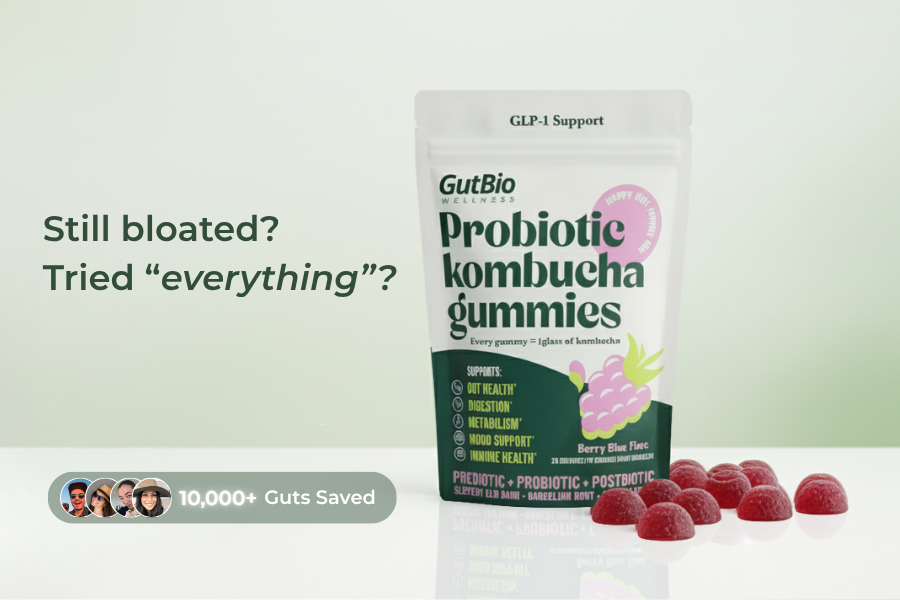
GutBio Kombucha Gummies are designed to support exactly this — combining prebiotics, probiotics, and postbiotics in a low-sugar daily gummy that is easy to stay consistent with. They are not a magic pill, but as part of the habits above, they are a straightforward way to make gut microbiome support something you actually do every day rather than something you mean to do.
If you want a sense of what to expect before committing, our honest, no-BS review of how kombucha gummies actually work is a good place to start. And if you are new to the world of probiotics entirely, the Complete Beginner's Guide to Probiotics breaks it all down in plain English.
Is it worth addressing gut health if your bloating feels hormonal?
Yes — and here is why that question matters. A lot of women in their 40s assume that hormonal bloating is just something to endure until menopause is over. That thinking keeps a lot of people stuck longer than they need to be.
Your gut and your hormones are not separate systems. As the estrobolome research above shows, the state of your gut microbiome directly influences how your body processes and responds to oestrogen. Supporting your gut health does not just improve digestion — it can help smooth out some of the hormonal fluctuations that drive the bloating in the first place.
The objection we hear most often is: "I have tried probiotics before and they did not do anything." That is a fair point — and often the reason is inconsistency, or a product that did not contain the right combination of strains and support ingredients. A probiotic taken for two weeks and then forgotten is not going to shift a gut microbiome that has been out of balance for years. The research supports consistent, long-term use — which is exactly why a 90-day approach tends to produce more meaningful results than a short trial. GutBio's 60-day money-back guarantee means you can test this properly without financial risk.
When should you talk to a doctor about bloating?
Most bloating in women over 40 is functional — meaning it is real and uncomfortable, but not a sign of serious disease. That said, there are symptoms that deserve a medical conversation sooner rather than later.
- Bloating that is constant, not cyclical, and getting progressively worse
- Unexplained weight loss alongside bloating
- Blood in your stool or significant changes in bowel habits
- Bloating accompanied by persistent pelvic pain
- A family history of ovarian or colorectal cancer
None of those symptoms describe normal hormonal bloating or standard digestive bloating. If any of them apply to you, please speak to your GP or primary care provider before trying any self-directed approach.
Frequently Asked Questions
How do I know for certain whether my bloating is hormonal or digestive?
Track it for two to three cycles: if the bloating appears predictably in the same phase of your cycle — particularly the week before your period — and is not clearly linked to specific foods, it is most likely hormonal. A symptom diary is one of the most useful tools you have, and many GPs will ask for exactly this information before suggesting any treatment.
Can improving gut health really help with hormonal bloating, or is that a stretch?
It is not a stretch — the gut-hormone connection is well established in the research. The estrobolome (the specific gut bacteria responsible for oestrogen metabolism) directly influences how your body manages circulating oestrogen. Supporting gut diversity through fibre, fermented foods, and live cultures can help regulate that process, which in turn can reduce the severity of hormonally driven bloating over time.
What is the GutBio 90-Day Gut Reset, and is it worth it?
The 90-Day Gut Reset is a three-month supply of GutBio Kombucha Gummies, priced at $66 (normally $120), designed to give your gut microbiome enough time to show meaningful change — research consistently shows that gut microbiome interventions need at least 60 to 90 days to produce lasting results. If you try it and are not satisfied, the 60-day money-back guarantee means you can get a full refund, no questions asked.
Are GutBio Kombucha Gummies safe for women in perimenopause?
GutBio Kombucha Gummies are formulated with food-grade probiotic strains and are generally well tolerated — they are low in sugar and do not contain artificial sweeteners, which is particularly relevant for women managing metabolic changes in perimenopause. As with any supplement, if you are on prescription medication or managing a diagnosed condition, it is worth checking with your doctor before starting something new.