

Can Probiotics Actually Help You Lose Weight? Here's What the Research Says
If you have spent any time Googling why your jeans feel tighter even though you have not changed your diet, or why your stomach looks six months pregnant by 3 p.m., you have probably stumbled across probiotics as a possible answer. And honestly? The promise sounds almost too good — swallow some friendly bacteria and watch the bloat and the pounds melt away. But here is the thing: the relationship between probiotics, weight loss, and bloating is real, nuanced, and way more interesting than most clickbait headlines let on. Let's actually dig into the research together, set some honest expectations, and figure out whether adding a probiotic to your routine is genuinely worth it — or just another wellness trend you will forget about in six weeks.
⭐ Save $54 on the 90-day plan — the time it takes for real gut microbiome change.
Your Gut Is Running a Parallel Operation You Know Nothing About
Inside your digestive tract right now, roughly 38 trillion microorganisms — bacteria, fungi, viruses, and other microbes — are making decisions that affect your energy, your hunger hormones, your inflammation levels, and yes, your weight. This community is called your gut microbiome, and scientists have only started mapping it seriously in the last two decades. What they have found is striking.
A landmark study published in Nature compared the gut bacteria of obese and lean twins and found consistent differences in microbial diversity. The obese twins had less diverse microbiomes — fewer species of bacteria and a higher ratio of a bacterial family called Firmicutes relative to Bacteroidetes. When researchers transplanted gut bacteria from obese mice into germ-free mice, the recipients gained significantly more fat than mice who received bacteria from lean donors. Same calories. Different microbiome. Different outcome.
What does that actually mean for you? Your gut bacteria influence how many calories you extract from the food you eat, how your body stores fat, how sensitive you are to insulin, and how hungry you feel throughout the day. Bacteria in your gut ferment fiber and produce short-chain fatty acids like butyrate, which help regulate appetite hormones like GLP-1 and PYY — the same hormones that tell your brain "okay, we are done eating now." When your microbiome is imbalanced, those signals get noisy. You might eat past fullness without realizing it. Your metabolism might run slightly less efficiently. Inflammation — a known driver of weight gain and metabolic dysfunction — can creep up quietly in the background.
This is not a fringe theory. A growing body of peer-reviewed research supports the idea that the gut microbiome is a meaningful player in metabolic health. If you want a deeper primer before going further, the Complete Beginner's Guide to Probiotics is a solid place to start — it covers the basics without the jargon overload.
Bloating vs. Fat: Why This Distinction Actually Matters
Here is something nobody in the wellness industry talks about clearly enough: a lot of what people experience as weight gain — especially around the midsection — is not fat at all. It is bloating. And bloating and fat have completely different causes, which means they respond to completely different interventions.
Bloating is typically the result of excess gas produced when gut bacteria ferment food, or from slowed motility — food sitting in your gut longer than it should. It can also stem from an overgrowth of the wrong kinds of bacteria (a condition called dysbiosis), food sensitivities, or low-grade gut inflammation. The result is a distended, uncomfortable, visually puffy abdomen that can add inches to your waistline by afternoon even if you ate perfectly.
Probiotics — particularly well-studied strains like Lactobacillus acidophilus, Bifidobacterium longum, and Lactobacillus plantarum — have shown meaningful results in clinical studies for reducing bloating, improving gut motility, and relieving the kind of functional digestive discomfort that makes everyday life miserable. A meta-analysis published in the American Journal of Gastroenterology found that probiotics significantly reduced bloating scores in patients with irritable bowel syndrome. Other research has shown improvements in transit time, meaning food moves through your system more efficiently and sits around fermenting less.
So can probiotics help with weight loss and bloating? For bloating specifically, the evidence is genuinely encouraging. You may notice your stomach looking and feeling flatter within weeks — not because you lost fat, but because your gut is finally processing food the way it is supposed to. That alone is worth something. And for many people, reducing bloating is the first step that makes them feel motivated enough to make bigger lifestyle changes.
What Probiotics Can Realistically Do for Fat Loss
Let's be straight with you: probiotics are not a fat-loss drug. If you eat in a significant caloric surplus every day and add a probiotic, you will not lose fat. That is just not how human biology works, and any brand telling you otherwise is selling you something you should be suspicious of.
What probiotics can do is support the conditions that make fat loss easier and more sustainable. Here is what the research actually suggests:
- Reducing low-grade inflammation: Chronic inflammation is tightly linked to insulin resistance and fat storage. Certain probiotic strains have been shown to lower inflammatory markers like CRP and IL-6, which may improve your body's ability to use glucose for energy rather than store it as fat.
- Improving insulin sensitivity: Some studies have found that specific probiotic strains improve insulin sensitivity in people with metabolic syndrome, which can make it easier to manage blood sugar and reduce fat storage — particularly visceral fat.
- Supporting appetite regulation: By producing short-chain fatty acids and supporting the gut lining, probiotics can help optimize the signaling of satiety hormones. Less random hunger. Fewer cravings that come out of nowhere at 10 p.m.
- Reducing fat absorption: Some research suggests certain Lactobacillus strains may slightly reduce the amount of dietary fat absorbed in the gut, though the effect size here is modest and should not be overstated.
- Improving sleep and stress resilience: The gut-brain axis is real. A healthier gut often means better mood regulation, lower cortisol, and better sleep — all of which have downstream effects on hunger hormones and fat storage.
A 2019 systematic review and meta-analysis published in Obesity Reviews analyzed 15 randomized controlled trials and found that probiotic supplementation produced a statistically significant, though modest, reduction in body weight, BMI, and fat percentage compared to placebo. The average weight loss was about 0.6 kg (roughly 1.3 lbs) over 8 weeks. Not dramatic. But measurable. And when you stack that on top of reduced bloating, better digestion, more stable energy, and improved appetite signaling, the cumulative effect on how you look and feel can be meaningfully more significant than that single number suggests.
Thousands of people have already made the switch. ★★★★★ 4.8 from 1,019 reviews.
The 90-Day Gut Reset Plan — $66 (normally $120)
Start My 90-Day Reset →Why Most Probiotics on the Market Do Not Actually Deliver
Here is where we need to have an honest conversation about delivery. The single biggest problem with most probiotic supplements is not the strains they contain — it is whether those strains survive long enough to reach your gut alive and in sufficient numbers to do anything useful.
Most probiotic capsules are exposed to stomach acid the moment you swallow them. Stomach acid is designed to kill microorganisms — that is literally its job. Studies have estimated that only a fraction of live bacteria in a standard capsule survive the journey through the stomach and into the colon where they can actually colonize and get to work. Refrigeration requirements, poor manufacturing practices, and long supply chains make the problem worse. You might be spending real money on a bottle of essentially dead bacteria.
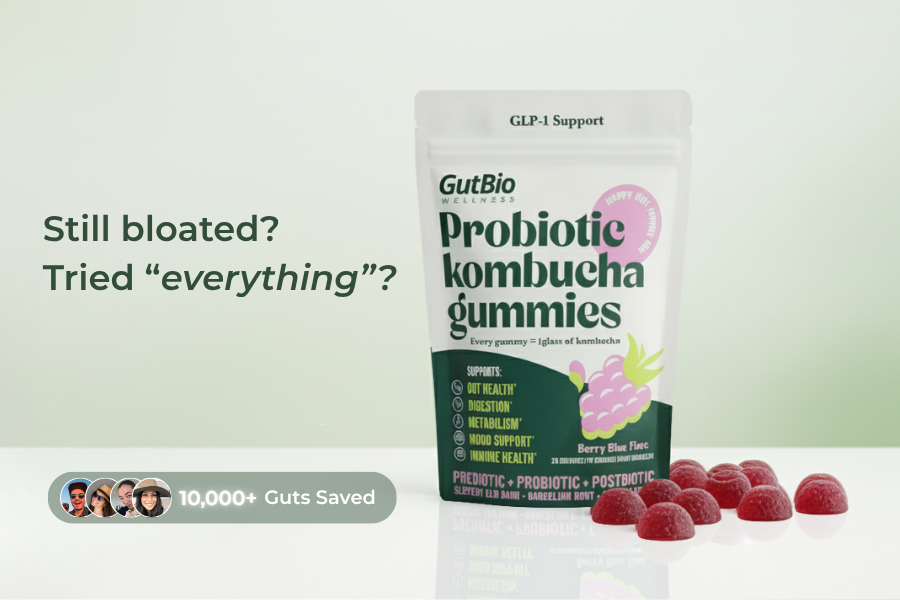
This is one of the reasons the formulation behind GutBio Kombucha Gummies takes a different approach. Rather than betting everything on live bacteria surviving stomach acid, GutBio combines prebiotics, probiotics, and postbiotics — which is why they call it a pre, pro, and postbiotic formula. Postbiotics are the metabolic byproducts of probiotic fermentation — things like butyrate, short-chain fatty acids, and cell wall fragments — and they are inherently more stable than live bacteria. They do not need to survive stomach acid because they are already the beneficial end-products. That means you are getting the gut-supportive compounds directly, regardless of whether every single live strain makes it to the finish line.
The kombucha base matters too. Kombucha is a traditionally fermented beverage with a documented history of supporting gut health, containing organic acids, B vitamins, and naturally occurring beneficial bacteria. GutBio uses this as the functional foundation of their gummy, which sets it apart from a standard sugar-bomb gummy slapped with a probiotic label.
And if you are wondering whether any of this actually translates to real-world results, the honest, no-BS review of GutBio Kombucha Gummies breaks down exactly what users experience — including the timeline for when most people start noticing changes.
The 30-Day Gut Reset: What to Expect on the Timeline
One of the most common reasons people quit probiotics before they work is impatience. Your gut microbiome is a complex ecosystem that took years to get into whatever state it is in right now. Recalibrating it does not happen overnight. Here is a realistic window of what to expect:
- Days 1–7: Some people notice changes in stool regularity and consistency almost immediately. Others experience a brief period of increased gas as the new bacterial strains compete with established residents. This is normal and typically short-lived.
- Days 8–14: Bloating often starts to ease noticeably during this window. Morning stomach puffiness may reduce. Digestive discomfort after meals may begin to lessen.
- Weeks 3–4: This is where most people report more consistent energy, less afternoon sluggishness, and a clearer sense that their digestion is running more smoothly. Appetite regulation often starts to improve around this time.
- Days 30–90: The cumulative effects of microbiome rebalancing — reduced inflammation, improved metabolic signaling, better nutrient absorption — tend to become more apparent. If weight or body composition is going to shift, this is typically when it starts to show.
GutBio's tagline — "Fix bloating in 30 days" — is backed by this timeline. For the bloating piece specifically, 30 days is a well-supported window based on clinical evidence. For broader metabolic benefits, giving it a full 90 days is the smarter play. That is exactly why the 90-Day Gut Reset option exists — because consistency over time is what actually moves the needle.
Addressing the Objection: "Is It Actually Worth It?"
Let's talk about this directly, because it is a fair question. You have probably tried things before — a supplement here, a detox there — and felt like you threw money into a hole. So why would this be different?
First, the mechanism here is not magic. It is documented, peer-reviewed biology. Your gut bacteria affect your metabolism. Improving your gut health improves your metabolic environment. That is not a claim — that is a research-backed chain of causation.
Second, the risk is genuinely low. GutBio comes with a 60-day money-back guarantee. That is two full months to try it, see how your gut responds, notice whether your bloating improves, track whether you feel different — and if it does not deliver, you get your money back. That kind of guarantee does not get offered by brands that are not confident in what they are selling. If you want to try GutBio risk-free, that guarantee has you covered.
Third — and this is worth sitting with — chronic bloating, poor digestion, and a sluggish metabolism are not just cosmetic inconveniences. They are signals that something in your gut ecosystem is off, and ignoring that tends to compound over time. The question is not really "is this worth $2 a day?" It is "what is it worth to me to feel consistently better, have more energy, and actually understand what is happening in my body?"
For the 1,019 people who have left GutBio Kombucha Gummies a five-star review — averaging 4.8 stars — the answer was clearly yes. Real people with real digestive struggles who found something that actually worked for them.
How to Get the Most Out of Your Probiotic (So It Actually Works)
Even the best probiotic is not a replacement for the basics. Here is how to set yourself up for actual results:
- Feed your good bacteria: Probiotics thrive when you give them fiber-rich prebiotic foods — garlic, onions, asparagus, bananas, oats. This is actually part of why the prebiotic component in GutBio's formula matters so much.
- Cut the microbiome killers: Excess alcohol, highly processed foods, and unnecessary antibiotic use are the fastest ways to undermine a healthy gut. You do not have to be perfect, but awareness helps.
- Be consistent: Taking a probiotic three days on, four days off, whenever you remember it, is a good way to get no results. Daily consistency is what allows microbial populations to actually shift.
- Give it time: Refer back to the timeline above. Trust the process for at least 30 days before drawing conclusions.
- Stay hydrated: Water supports gut motility and helps the entire digestive process run more efficiently — including probiotic colonization.
Pair those habits with a quality probiotic and you are not just taking a supplement — you are actively creating an internal environment where fat loss, reduced bloating, and better metabolic health are genuinely more achievable.
The Bottom Line on Probiotics and Weight Loss
So, can probiotics help with weight loss and bloating? Here is the honest answer: yes, but with appropriate context. For bloating, the evidence is strong and the results can be noticeable within weeks. For fat loss, probiotics support the metabolic conditions that make weight management easier — reduced inflammation, better appetite signaling, improved insulin sensitivity — but they are not a shortcut around diet and movement. They are a meaningful piece of a bigger picture.
What makes GutBio Kombucha Gummies worth considering specifically is the combination of pre, pro, and postbiotics in a form that is designed to actually reach your gut and do something useful — backed by a company confident enough to offer a 60-day money-back guarantee and a customer base with over a thousand five-star reviews to show for it.
If your gut has been making your life harder — the bloating, the discomfort, the unexplained weight that does not respond the way it used to — your microbiome is worth taking seriously. This is one of the most researched areas in