

Best Probiotics for Women Over 40: What to Actually Look For
The best probiotics for women over 40 include clinically studied strains such as Lactobacillus acidophilus and Bifidobacterium longum, a combination of prebiotics, probiotics, and postbiotics, low or no added sugar, and ideally some botanical support. This article walks through exactly what those criteria mean — and why each one matters for gut health in your 40s and beyond.
⭐ Save $54 on the 90-day plan — the time it takes for real gut microbiome change.
Why does gut health become a bigger priority in your 40s?
The short answer: hormonal shifts that begin around perimenopause have a direct, documented effect on the gut microbiome. Research published in mBio and supported by data from the National Institute of Child Health and Human Development shows that declining estrogen levels are associated with reduced microbial diversity in the gut — the variety of beneficial bacteria that keeps digestion running smoothly.
Estrogen receptors are found throughout the gastrointestinal tract. As estrogen fluctuates and eventually decreases, the gut's microbial ecosystem can shift in composition. This is one reason many women in their 40s notice digestive changes that feel different from anything they experienced in their 20s or 30s.
At the same time, two other things tend to happen with age: digestive enzyme production naturally slows, and gut transit time can lengthen. Both of these changes make the quality and diversity of a probiotic supplement more important, not less.
Understanding this biological context is the first step toward choosing a probiotic that is actually formulated to meet those needs — rather than just any generic capsule off the shelf.
What should you actually look for in a probiotic for women over 40?
Not all probiotics are built the same. The label on a jar might list billions of CFUs, but CFU count alone says very little about whether a product will support your gut effectively. Here is a checklist of the criteria that matter most, based on current research.
1. Clinically studied probiotic strains
Strain specificity is everything. A probiotic strain is identified by its genus, species, and strain designation — for example, Lactobacillus acidophilus NCFM. General claims about "Lactobacillus" without strain identification are a red flag. For women over 40, the strains with the strongest research support for digestive and microbiome health include:
- Lactobacillus acidophilus — among the most studied strains for gut microbiome support; found naturally in the small intestine
- Bifidobacterium longum — particularly well-researched in the context of gut comfort and regularity; levels of this genus tend to decline with age
- Lactobacillus rhamnosus — widely studied for gut barrier and microbiome diversity support
- Bifidobacterium lactis — associated with gut motility and transit time in several clinical trials
For a deeper dive into how individual strains work, see our Complete Beginner's Guide to Probiotics.
2. A full synbiotic: prebiotics + probiotics + postbiotics
Most probiotic products deliver only live bacteria (probiotics). A more complete approach layers in:
- Prebiotics — dietary fibres (such as inulin or FOS) that feed beneficial bacteria already living in the gut
- Probiotics — the live cultures themselves
- Postbiotics — metabolic byproducts of fermentation (including short-chain fatty acids and certain organic acids) that support the gut lining and microbial environment
Think of probiotics as the seeds, prebiotics as the soil and water, and postbiotics as the compost that enriches the environment further. All three together — sometimes called a synbiotic — give beneficial bacteria the best conditions to take hold and function.
Kombucha-based formulations are naturally well-suited to this approach because the fermentation process that produces kombucha inherently generates organic acids, B vitamins, and bioactive compounds alongside live cultures.
3. Low or no added sugar
This criterion matters more than it might seem. Excess sugar in the diet is associated with changes in microbial composition — specifically, it can favor less desirable bacterial populations over the Lactobacillus and Bifidobacterium families you want to support. A probiotic supplement loaded with added sugar is, to some degree, working against itself.
Many gummy supplements on the market contain 3–5 grams of added sugar per serving. Look for products that keep added sugar to 1 gram or less per serving, or that use alternative sweeteners with a more neutral effect on the microbiome.
4. Botanical support where appropriate
Some formulations include botanical ingredients — ginger, fennel, peppermint, or apple cider vinegar — that have a long history of use alongside digestive support. These are not medical treatments, but they can contribute to a well-rounded gut-support formula when included at meaningful levels (not just trace amounts for label appeal).
5. Survivability through the digestive tract
Live probiotic cultures face a challenging journey: stomach acid, bile salts, and enzymes can significantly reduce the number of live bacteria that actually reach the colon. Look for formulations that use acid-resistant strains or protective delivery mechanisms (such as delayed-release capsules or fermented matrices that buffer the cultures).
Fermented-food formats, including kombucha-based gummies, can offer a degree of natural buffering because the fermentation process produces an acidic environment that the cultures have already adapted to survive in.
Thousands of people have already made the switch. ★★★★★ 4.8 from 1,019 reviews.
The 90-Day Gut Reset Plan — $66 (normally $120)
Start My 90-Day Reset →How does GutBio Kombucha Gummies fit these criteria?
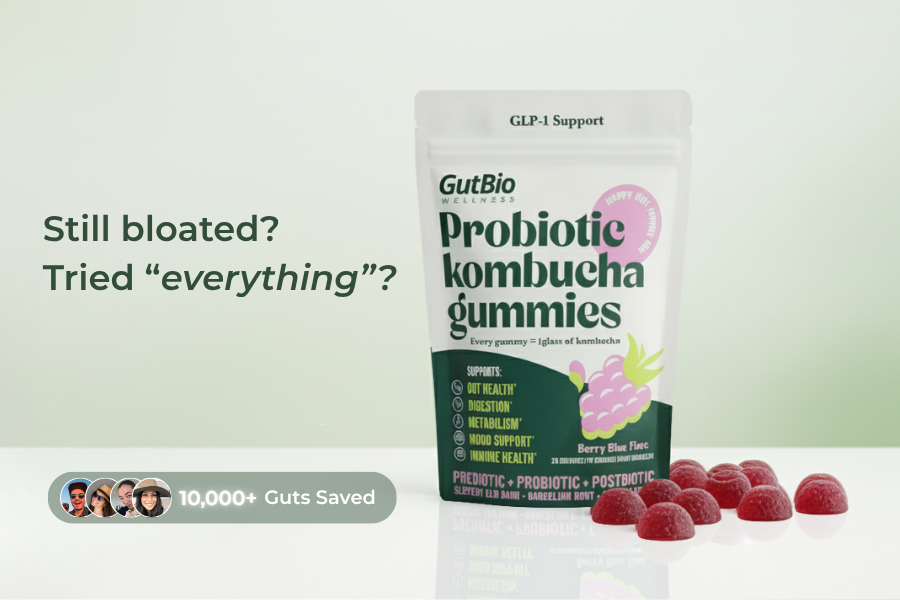
GutBio Kombucha Gummies are formulated specifically to check each of the boxes above. Here is how the product maps against the criteria outlined in this article.
| Criteria | What to look for | GutBio Kombucha Gummies |
|---|---|---|
| Probiotic strains | Named, clinically studied strains | Contains studied Lactobacillus and Bifidobacterium strains in a kombucha fermentation base |
| Full synbiotic | Prebiotics + probiotics + postbiotics | Pre, pro, and postbiotic formula — all three included in one daily gummy |
| Sugar content | Low or no added sugar | Low-sugar formula; designed to avoid the excess-sugar issue common in gummy supplements |
| Botanical support | Meaningful botanical additions | Kombucha fermentation base provides naturally occurring organic acids and bioactive compounds |
| Survivability | Cultures that survive to the gut | Fermented matrix helps buffer live cultures through digestion |
| Format | Easy daily habit | Gummy format — no capsules to swallow, no powder to mix |
GutBio is rated 4.8 stars from 1,019 reviews, and the product comes with a 60-day money-back guarantee — so there is no financial risk in trying it as part of a daily routine. If you want to try GutBio risk-free, that guarantee means you can assess it over two full months before committing.
Curious whether kombucha-based gummies actually deliver? Our team covered that question in detail here: Do Kombucha Gummies Actually Work? An Honest, No-BS Review.
What else supports a healthy gut microbiome for women over 40?
A daily probiotic supplement is one useful tool — but it works best as part of a broader lifestyle that supports microbial diversity. Here are the evidence-based foundations worth building first.
1. Dietary fibre — aim for around 25g per day
The 2020–2025 Dietary Guidelines for Americans recommend approximately 25 grams of fibre per day for adult women. Most adults consume roughly half that. Fibre is the primary food source for beneficial gut bacteria — without it, even the best probiotic supplement has limited raw material to work with. Good sources include legumes, oats, flaxseed, vegetables, and fruit with the skin on.
2. Fermented foods alongside supplements
Whole fermented foods — plain yogurt, kefir, kimchi, sauerkraut, miso — contribute live cultures and a range of organic acids that support microbial diversity. A 2021 study published in Cell found that a diet high in fermented foods increased microbiome diversity and reduced markers of immune activation in adults. Supplements and food sources work well together; neither replaces the other.
3. Consistent sleep and stress management
The gut-brain axis is a genuine bidirectional communication system. Chronic sleep disruption and elevated cortisol are both associated with shifts in gut microbiome composition. Prioritising 7–8 hours of sleep and consistent stress-management practices (movement, breathwork, time outdoors) is not separate from gut health — it is directly connected to it.
4. Regular movement
Physical activity is independently associated with greater gut microbial diversity. Even moderate-intensity movement — 30 minutes of walking most days — has been shown in several observational studies to correlate with a more diverse microbiome compared to sedentary patterns.
5. A daily probiotic as the easy, consistent layer
The practical challenge with fermented foods, fibre goals, and sleep hygiene is consistency. A daily probiotic supplement fills in the gaps and provides a reliable daily input of live cultures regardless of how the rest of the day went. GutBio Kombucha Gummies are designed to be the frictionless part of the routine — two gummies a day, no prep, no mixing, no refrigeration required.
"A diverse gut microbiome is built over time through consistent inputs — diet, movement, sleep, and targeted supplementation. No single step does all the work." — GutBio Wellness Team
Does the format of a probiotic (gummy vs. capsule vs. powder) actually matter?
Format matters primarily because of two factors:
These statements have not been evaluated by the Food and Drug Administration. This product is not intended to diagnose, treat, cure, or prevent any disease. Individual results may vary. Always consult your healthcare provider before starting any new supplement.