

Can Probiotics Actually Help You Lose Weight? Here's What the Research Says
If you have ever stood in front of the mirror feeling like your stomach is working against you — bloated after a meal that should have been fine, pants tight by noon even though you have been eating well, energy in the basement — you have probably wondered whether your gut is part of the problem. Maybe someone mentioned probiotics. Maybe you have already tried a few things and felt nothing. Before you write the whole category off, it is worth looking at what the science actually says, because the gut-weight connection is real — it is just more nuanced than the headlines make it sound. This is not a hype piece. It is an honest breakdown of what probiotics can do, what they cannot, and whether they are worth adding to your routine.
⭐ Save $54 on the 90-day plan — the time it takes for real gut microbiome change.
Your Gut Bacteria and Your Metabolism Are More Connected Than You Think
Inside your digestive tract lives a community of trillions of microorganisms — bacteria, fungi, and other microbes — collectively called the gut microbiome. This ecosystem is not just involved in digestion. It communicates directly with your brain, your immune system, and your metabolism. Research published in Nature and other top-tier journals has shown that the composition of your gut bacteria can influence how many calories you extract from food, how your body stores fat, and how your hunger hormones behave.
Two bacterial families get talked about the most in this context: Firmicutes and Bacteroidetes. Studies have consistently found that people with obesity tend to have a higher ratio of Firmicutes to Bacteroidetes compared to lean individuals. Firmicutes are particularly efficient at breaking down carbohydrates and extracting energy from food — which sounds useful, but when that extraction is happening with every meal, it can contribute to surplus calorie absorption that your body stores as fat.
Beyond calorie extraction, gut bacteria also produce short-chain fatty acids (SCFAs) like butyrate, propionate, and acetate. These compounds regulate appetite hormones like GLP-1 and peptide YY — the same hormones that signal fullness to your brain. A well-balanced microbiome produces more of these appetite-regulating SCFAs. A disrupted one produces less, which can leave you feeling hungry sooner than you should. Understanding this connection is foundational to understanding whether probiotics can help with weight loss and bloating — and why gut health is not just a wellness buzzword.
If you are new to all of this, the Complete Beginner's Guide to Probiotics is a solid place to start before going deeper into the research.
Bloating vs. Body Fat: Why This Distinction Matters
Here is something most supplement brands will not tell you clearly: a lot of what people experience as looking "heavier" or "puffy" — especially around the midsection — is not fat at all. It is gas and water retention driven by a dysregulated gut. This is important because probiotics are likely to have a much faster and more noticeable effect on bloating than on body fat, and conflating the two leads to either unrealistic expectations or missed wins.
When your gut microbiome is out of balance — a state called dysbiosis — certain bacteria overproduce gas when they ferment food. This leads to that uncomfortable, distended stomach feeling that hits after meals, makes waistbands feel tighter by evening, and leaves you looking and feeling bloated even when you have not overeaten. Dysbiosis also disrupts the gut lining, which can increase intestinal permeability (sometimes called "leaky gut"), triggering low-grade inflammation that contributes to water retention throughout the body.
Probiotics address this at the root. By rebalancing the bacterial environment in your gut, they reduce the overgrowth of gas-producing strains, support the integrity of the gut lining, and calm the inflammatory signals that cause the body to hold onto fluid. Clinical trials on strains like Lactobacillus acidophilus and Bifidobacterium longum have shown meaningful reductions in bloating and abdominal discomfort within four to eight weeks. For many people, this visible reduction in bloat is their first noticeable sign that things are improving — and it can happen well before any changes on the scale.
So if you are asking can probiotics help with weight loss and bloating, the honest answer is: for bloating, the evidence is quite strong. For fat loss directly, it is more of a supporting role — but that supporting role matters more than most people realize.
What the Research Actually Says About Probiotics and Weight Loss
Let us talk about the clinical evidence without glossing over the inconvenient parts. A 2019 systematic review published in the International Journal of Obesity analyzed 27 randomized controlled trials and found that probiotic supplementation was associated with modest but statistically significant reductions in body weight, BMI, fat percentage, and waist circumference compared to placebo. The word "modest" is doing real work in that sentence — we are typically talking about one to two pounds over twelve weeks, not dramatic transformation.
But here is the more compelling angle: probiotics appear to make other healthy behaviors more effective. When your gut is producing SCFAs properly, your body responds better to dietary changes. When your hunger hormones are better regulated, you are less likely to overeat. When inflammation is reduced, your body is more willing to release stored fat. Probiotics do not replace a calorie deficit or consistent movement — but they can make the environment inside your body more cooperative with the efforts you are already making.
A 2021 study in Frontiers in Nutrition specifically looked at postbiotics — the beneficial compounds produced by probiotic bacteria during fermentation — and found promising effects on fat metabolism and insulin sensitivity. This is why newer formulations that combine prebiotics, probiotics, and postbiotics together are generating so much interest in clinical research. Each component plays a different but complementary role: prebiotics feed the beneficial bacteria, probiotics supply them, and postbiotics deliver some of the downstream metabolic benefits directly.
"Probiotics are not a weight loss drug. They are a metabolic support system. The goal is to make your body work the way it was designed to."
Thousands of people have already made the switch. ★★★★★ 4.8 from 1,019 reviews.
The 90-Day Gut Reset Plan — $66 (normally $120)
Start My 90-Day Reset →Why Most Probiotic Products Fail to Deliver (And What to Look for Instead)
This is the part of the conversation that gets skipped most often, and it is the reason so many people try a probiotic for a month and feel nothing. Not all probiotic products are equal — not even close — and the differences matter enormously for whether you actually get results.
First, survivability. Most probiotic bacteria are fragile. They die in the acidic environment of your stomach before they ever reach the colon where they need to work. Many capsule-based probiotics on shelves have lost half their potency before you even open the bottle, because they were not stored, formulated, or encapsulated correctly. The CFU count on the label means nothing if those organisms are dead on arrival.
Second, strain specificity. Different bacterial strains do different jobs. A product with ten strains sounds impressive, but if none of them are clinically studied for the outcomes you care about, you are just buying a very expensive placebo. Research on Lactobacillus rhamnosus, for example, has specifically linked this strain to reductions in visceral fat. Research on Bifidobacterium breve has shown effects on fat mass. Strain selection is not marketing — it is mechanism.
Third — and this is the newest and arguably most important development — postbiotics. As mentioned above, postbiotics are the metabolic byproducts generated during fermentation. They include things like short-chain fatty acids, enzymes, and cell wall fragments that have direct effects on the gut lining, immune function, and metabolism. Kombucha, for example, is a naturally fermented beverage rich in postbiotics, organic acids, and beneficial compounds that are produced during its brewing process. This is why fermentation-derived formulas are increasingly preferred over standard probiotic capsules.
This is exactly what GutBio Kombucha Gummies were formulated around. Rather than a standard probiotic capsule with a questionable survivability rate, GutBio uses a pre, pro, and postbiotic blend powered by real kombucha fermentation — keeping the sugar low and the potency high. If you want to see an unfiltered breakdown of how the product actually performs, this honest review of GutBio Kombucha Gummies covers the details without the marketing spin.
Realistic Expectations: What 30 to 90 Days Actually Looks Like
Let us be straightforward about timelines, because unrealistic expectations are the number one reason people abandon a supplement before it has had a chance to work. Your gut microbiome is a living ecosystem that took years to get into its current state. Meaningful, lasting change does not happen in a week. Here is a more accurate picture of what to expect:
- Days 1–14: Many people notice changes in bloating and digestive comfort within the first two weeks. Gas may reduce, bowel movements may become more regular, and that persistent afternoon bloat often starts to soften. For some people this happens faster; for others it takes the full two weeks.
- Weeks 3–4: The microbiome is beginning to shift. Beneficial strains are establishing themselves. Energy may start to feel more stable. The gut-brain connection means mood and mental clarity sometimes improve around this point too — an unexpected but frequently reported benefit.
- Month 2–3: This is when the deeper metabolic shifts begin to show up for people who are also eating reasonably well and staying active. Appetite regulation improves. Inflammation markers tend to reduce. Waist measurements — particularly visceral fat — respond to the combined effect of a healthier gut environment and whatever other lifestyle habits you are maintaining.
The 90-Day Gut Reset approach exists because ninety days is genuinely the minimum for seeing the full picture of what probiotic support can do. Thirty days tells you whether your gut is responding. Sixty days shows the momentum. Ninety days reveals the shift. That is why GutBio structures its most popular option around this timeline — and why, if you want to try it risk-free, there is a 60-day money-back guarantee backing the commitment.
Addressing the Objections: Is This Actually Worth It?
Fair question. You have probably tried things before that did not work. Maybe you have tried a standard probiotic capsule and felt nothing after a month. Maybe you are skeptical about whether any supplement can make a real difference when your diet is not perfect. Here are the most common objections — answered honestly.
"I tried probiotics before and nothing happened." This is the most common one, and the most valid. The majority of probiotic products on the market have survivability and formulation issues that mean the bacteria simply never reach your colon in meaningful numbers. A kombucha-based postbiotic formula works through a different mechanism — the fermentation byproducts are already bioavailable, which is why many people who felt nothing from standard probiotics notice a tangible difference with GutBio.
"Can't I just eat fermented foods?" You can, and you should — yogurt, kefir, kimchi, and sauerkraut are excellent. But the doses of specific clinically studied strains in fermented foods are inconsistent and often low. A targeted supplement lets you get consistent, strain-specific support that food alone rarely delivers at therapeutic levels.
"What if I don't like it?" This is where the 60-day money-back guarantee matters. You have two full months to try GutBio and decide whether it is working for you. If it is not, you get your money back — no hoops, no hassle. That kind of guarantee only exists when a company is confident in what their product actually does.
"Will it work without changing my diet?" Honestly? You will likely see some improvement in bloating and digestive comfort regardless of diet, because that is largely about microbiome balance rather than calories. For meaningful weight-related changes, gut support works best as part of a broader approach — better food choices, more movement, less chronic stress. Probiotics create a better internal environment; what you do in that environment still matters.
How GutBio Kombucha Gummies Fit Into the Picture
GutBio Kombucha Gummies were built specifically for people who want gut support that is grounded in science rather than marketing. The formula combines prebiotics (to feed beneficial bacteria), probiotics (clinically studied strains at survivable doses), and postbiotics derived from real kombucha fermentation — giving you the full spectrum of gut support in one low-sugar gummy that actually tastes good.
With over 1,019 reviews averaging 4.8 stars, the feedback from real users consistently centers on three things: reduced bloating within the first few weeks, improved digestive regularity, and a general sense of feeling less inflamed and more comfortable in their own skin. The weight-related changes tend to follow for those who stick with it past the thirty-day mark — which is why the 90-day option exists and why so many customers choose it.
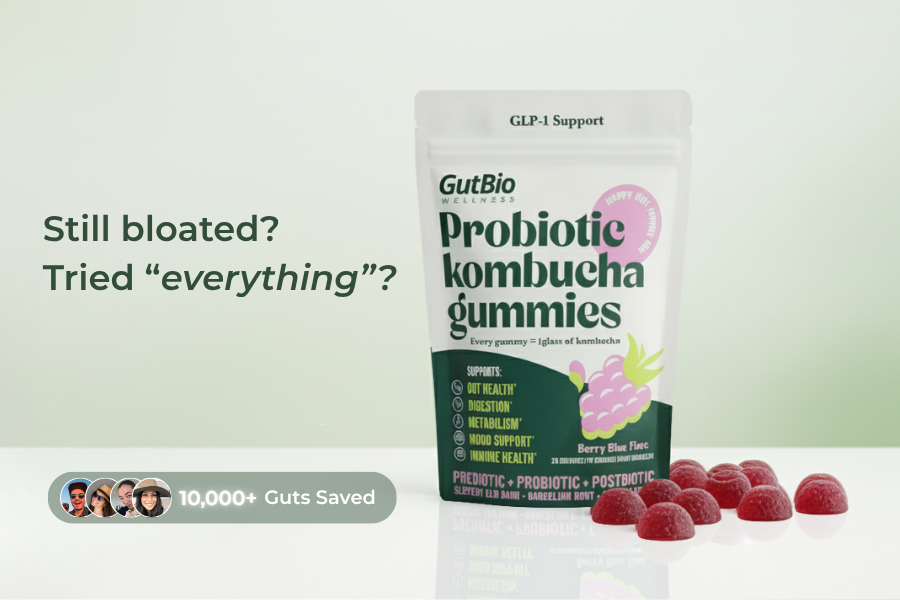
The tagline — "Fix bloating in 30 days with the only low-sugar gummy powered by pre, pro, and postbiotics" — is specific on purpose. Thirty days for bloating is a reasonable, evidence-based promise. The weight and metabolic support is a longer game, and GutBio does not pretend otherwise. That kind of honesty is, frankly, rare in this space.
If you are ready to give your gut the structured support it needs, you can learn more and get started at GutBio Kombucha Gummies.
Frequently Asked Questions
Can probiotics help with weight loss and bloating at the same time?
Yes — but they work through somewhat different mechanisms and on different timelines. For bloating, probiotics address the bacterial imbalances that cause excess gas production, intestinal permeability, and inflammation-related water retention. Many people see meaningful improvement in bloating within two to four weeks. For weight loss, probiotics play a supporting metabolic role — improving appetite hormone regulation, reducing low-grade inflammation, and helping the body extract fewer excess calories from food. This tends to show up more clearly over a sixty to ninety day period, particularly when combined with reasonable diet and movement habits. The two benefits are related because they both stem from a healthier